XLKitLearn · Reference

XLKitLearn Documentation

Introduction

Using this guide

This guide contains one section for each of the add-in's key functionality areas, followed by a reference guide to all the Excel functions available in the add-in.

Looking to quickly get started? Each section starts with a "quickstart" guide.

→

Looking for a specific excel function? Use the search box in the table of contents on the left.

XLKitLearn is compatible with Excel for Windows, Mac, and the web. In Excel, open Home → Add-ins → More Add-ins, search for XLKitLearn, and add it to your workbook.

Guide · Predict

Predict

Fit and compare predictive models, evaluate their performance, and score new observations directly from Excel.

Quickstart

→

Are you currently taking CBS's Business Analytics core class? That class does not use XLKitLearn's Predict module—instead, it directly uses XLKitLearn's machine-learning prediction functions. Click here for details.

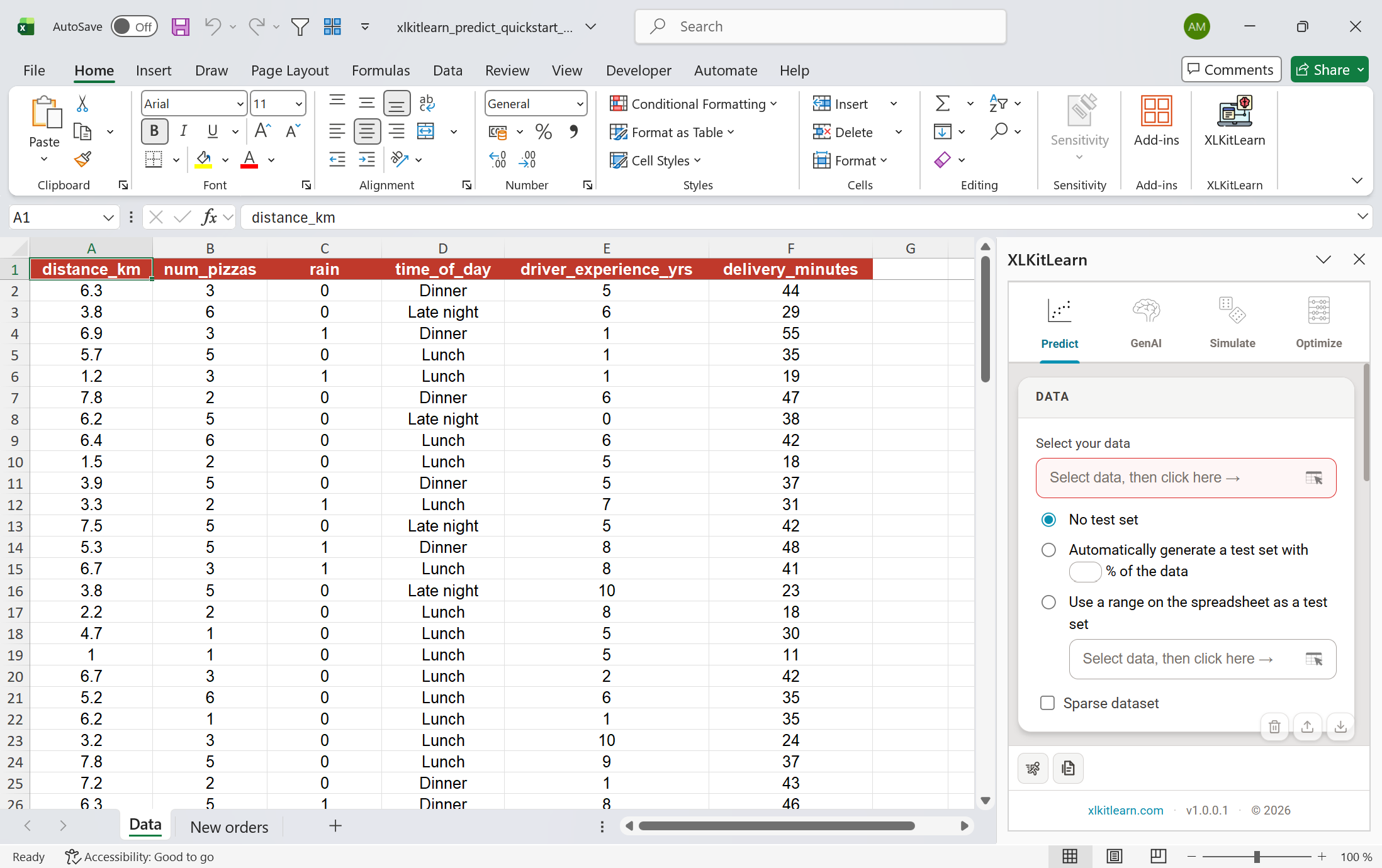
Imagine you run a pizza shop and want to give customers more accurate delivery estimates. In this quickstart, you'll use XLKitLearn's Predict module to learn from 100 completed orders and estimate delivery times based on distance, order size, rain, time of day, and driver experience. Along the way, you'll train and evaluate a model, then use it to predict delivery times for new orders. Follow along with the steps below...

Step 1 of 11
Excel with the XLKitLearn Predict pane open
Open

Open the Predict tab

  1. Download the sample workbook by clicking here, and open it. The "Data" tab contains the 100 completed pizza orders we will use to predict delivery times (the last column). Each row represents one completed order; each column describes that order, such as its distance, number of pizzas, weather, or delivery time.
  2. On Excel's Home tab, click XLKitLearn. The add-in pane opens on the right.
  3. At the top of the pane, click Predict.
Guide · GenAI

GenAI

User manual coming soon

Guide · Simulate

Simulate

User manual coming soon

Guide · Optimize

Optimize

User manual coming soon

Reference guide

Function reference

The list below is a comprehensive list of every function in the add-in. Use the search on the left to filter these functions.

Spilled range Click to run

Machine learning - model fitting

Fit reusable models and use them to generate predictions for new data.

Fit a linear regression model from a table and either a formula or an outcome-column name. Returns a reusable model with a complete coefficient table in its coefficients property.

Parameters
data

Training data including a header row. Column names are used by the formula.

formula

A model formula such as y ~ x1 + x2, or just the outcome-column name to use every other column as a predictor.

Returns

Returns an XLKitLearn Model entity with a complete coefficient table that is accessible through its coefficients property.

Working example

Paste the contents of your clipboard into Cell A1 of a worksheet

Fit a logistic regression model from a table and either a formula or an outcome-column name. The outcome must contain at most two distinct values, and every value must be the number 0 or 1.

Parameters
data

Training data including a header row. Column names are used by the formula.

formula

A model formula such as y ~ x1 + x2, or just the outcome-column name to use every other column as a predictor.

Returns

Returns an XLKitLearn Model entity with a complete coefficient table that is accessible through its coefficients property.

Working example

Paste the contents of your clipboard into Cell A1 of a worksheet

Fit a k-nearest-neighbors model from a table and either a formula or an outcome-column name. Numeric outcomes produce a regressor and nonnumeric outcomes produce a classifier.

Parameters
data

Training data including a header row. Column names are used by the formula.

formula

A model formula such as y ~ x1 + x2, or just the outcome-column name to use every other column as a predictor.

k

The positive whole number of nearest neighbors to use.

row_to_exclude optional

Optional training-data row to leave out of the fitted model. Row 1 is the first row after the header.

Returns

Returns an XLKitLearn Model entity that can be passed to predict.

Working example

Paste the contents of your clipboard into Cell A1 of a worksheet

Machine learning - helpers

Evaluate model performance, inspect classification results, and transform data for modeling and visualization.

Calculate the coefficient of determination (R-squared) using scikit-learn's r2_score.

Parameters
y_true

A row or column containing the observed numeric values.

y_pred

A row or column containing the predicted numeric values, in the same observation order as y_true.

Returns

Returns the same R-squared value as sklearn.metrics.r2_score.

Working example

Paste the contents of your clipboard into Cell A1 of a worksheet

Calculate root mean squared error using scikit-learn's mean_squared_error.

Parameters
y_true

A row or column containing the observed numeric values.

y_pred

A row or column containing the predicted numeric values, in the same observation order as y_true.

Returns

Returns the square root of sklearn.metrics.mean_squared_error.

Working example

Paste the contents of your clipboard into Cell A1 of a worksheet

Calculate binary or multiclass ROC AUC using scikit-learn. Class labels are converted to text and sorted in ascending Python string order, matching XLKitLearn model fitting. For binary data, a score vector must contain the probability of the second (larger) class in that sorted order. For a probability table, columns must follow the complete sorted class order. Multiclass AUC uses one-vs-one averaging.

Parameters
y_true

A row or column containing the observed class labels.

y_pred

Either one probability per observation for the larger of two sorted classes, or a probability table with one row per observation and one column per class in ascending Python string-sort order.

Returns

Returns the same binary ROC AUC or one-vs-one multiclass ROC AUC as sklearn.metrics.roc_auc_score.

Working example

Paste the contents of your clipboard into Cell A1 of a worksheet

Create a confusion matrix from observed and predicted class labels. Labels are converted to text and sorted in ascending order.

Parameters
y_true

A row or column containing the observed class labels.

y_pred

A row or column containing the predicted class labels, in the same observation order as y_true.

Returns

Returns a table whose rows are observed classes, columns are predicted classes, and cells contain observation counts.

Working example

Paste the contents of your clipboard into Cell A1 of a worksheet

Calculate a binary ROC curve from observed class labels and prediction scores, using at most 20 distinct score thresholds.

Parameters
y_true

A row or column containing the observed labels for exactly two classes.

y_pred

A row or column containing the predicted probability or score for the second class in ascending string-sort order.

Returns

Returns a two-column table headed False positive rate and True positive rate.

Working example

Paste the contents of your clipboard into Cell A1 of a worksheet

Use an XLKitLearn model entity to make predictions for new rows of data. The input data should include column headers matching the variables the model was trained on.

Parameters
model

XLKitLearn Model entity returned by fitLinearRegression or by the main XLKitLearn modeling workflow.

data

Rows to score, including a header row. Use the same feature column names and compatible data types as the training data.

Returns

Returns a spilled prediction table with a header row. Regression output is headed Prediction; classification output is headed by the model's class levels.

Working example

Paste the contents of your clipboard into Cell A1 of a worksheet

Perform multidimensional scaling (MDS) to reduce high-dimensional numeric data to two dimensions. Use this to create coordinates for visualizing similarity or distance among rows.

Parameters
data

Numeric data to reduce, with one row per item and one column per original dimension. Do not include headers.

seed optional

Optional random seed for reproducible coordinates. Defaults to 123.

n_init optional

The number of random initializations to try

Returns

Returns a two-column spilled matrix of MDS coordinates, one row per input row.

Working example

Paste the contents of your clipboard into Cell A1 of a worksheet

Calculate the sigmoid of a number 1 / (1 + exp(-x))

Parameters
x

The number to calculate the sigmoid of

Returns

Returns the sigmoid of the numbers input

Working example

Paste the contents of your clipboard into Cell A1 of a worksheet

GenAI - core

Send prompts to language models and create embeddings through OpenRouter.

Ask a model from OpenRouter to respond to a prompt, continue from a previous LLM Output entity, call workbook tools, or return a structured response. New model calls require Click to run from the GenAI tab.

Parameters
message

Prompt or conversation context. Pass a single cell for one prompt, or a vertical range containing prompt text and prior LLM Output entities to continue a conversation.

model optional

Optional OpenRouter model ID or alias. Leave blank to use openrouter/auto. Supported aliases include chatgpt, claude, gemini, grok, and deepseek; full IDs from the OpenRouter model list also work.

tools optional

Optional range of LLM Tool entities created by functions such as sqlTool, runPythonTool, sendEmailTool, or googleMapsPlacesSearchTool. Tools cannot be used in the same call as response_format.

response_format optional

Optional structured output format. Pass one or more Response format field entities from getResponseFormatField, or pass one of the simple strings integer, boolean, or number. Cannot be used in the same call as tools.

reasoning optional

Reasoning effort for models that support it. Use higher effort for harder analysis and lower or none for faster, cheaper simple tasks.

temperature optional

Sampling temperature between 0 and 2. Lower values are more focused and repeatable; higher values are more varied. Defaults to the model/provider behavior.

max_tokens optional

Optional maximum number of output tokens to generate. Some models do not support this parameter. Default value will be 5000.

auto_tool_run optional

TRUE to automatically run any tool calls returned by the model. FALSE to return Tool Call entities in the .tool_calls table so you can run each call manually with its corresponding Tool function.

Returns

Returns an LLM Output entity. Use dot notation to pull these fields into cells:

  • Content: the model's text response
  • .tool_calls: a table of function names, IDs, and Tool Call entities
  • field_<field name>: each named structured-output value
  • Usage, cost, timing, model, provider, and reasoning metadata
  • Hidden continuation JSON used when the entity is passed into another llm call

For large outputs, inspect the entity in the side bar.

Working example

Paste the contents of your clipboard into Cell A1 of a worksheet

Create an embedding vector for text, or for an image when the chosen embedding model supports images. This function is staged when it would make a new model call: after the formula shows Ready to run, select it and click Run staged cells in selection in the GenAI tab of the side bar.

Parameters
text

Text to embed, or an Excel image entity when using an image-capable embedding model.

model optional

Embedding model to use. Leave blank or use openai for openai/text-embedding-3-small; use gemini for google/gemini-embedding-2-preview; or provide another OpenRouter embeddings model ID.

Returns

Returns an Embedding entity with token count, cost, timing, model/provider metadata, and a hidden Embedding value. Use dot notation on the returned entity to spill the numeric vector for similarity search, clustering, or downstream modeling.

Working example

Paste the contents of your clipboard into Cell A1 of a worksheet

GenAI - helpers

Define structured responses, inspect tokenization, and analyze token probabilities.

Create one named field for a structured LLM response. Use this helper when you want llm to return predictable fields instead of free-form text: create one field per value you want back, then pass the resulting cells to the response_format argument of llm.

Parameters
short_name

Short field name to use in the structured output. Keep it simple, unique, and spreadsheet-friendly, for example category, score, or reasons.

parameter_type

Data type the model should return for this field: integer, number, string, or boolean.

description optional

Plain-language instruction for the model explaining what belongs in this field. Be specific about units, allowed values, and how to handle uncertainty.

is_list optional

TRUE if this field should contain a list of values. Leave blank or FALSE for a single value.

Returns

Returns a Response format field entity. Pass one or more of these entities into llm as response_format; use the shorter strings integer, number, or boolean when you only need one simple scalar output.

Working example

Paste the contents of your clipboard into Cell A1 of a worksheet

Split text into model-style tokens using the local cl100k_base tokenizer. This is useful for estimating prompt length, inspecting how text is tokenized, or teaching tokenization behavior without making an API call.

Parameters
text

Text, number, or boolean value to tokenize. It is converted to text before tokenization.

Returns

Returns a single spilled row containing one decoded token per column.

Working example

Paste the contents of your clipboard into Cell A1 of a worksheet

Generate up to 100 tokens with GPT-4.1 and show token-by-token probability alternatives. This function is staged when it would make a new model call: after the formula shows Ready to run, select it and click Run staged cells in selection in the GenAI tab of the side bar.

Parameters
message

Single prompt to send to the model. Use plain text, a number, or a boolean; conversation entities and ranges are not supported here.

Returns

Returns a formatted spill range. The left columns contain prompt, completion, model, provider, date, cache status, token usage, and cost; the remaining columns show each selected output token and the top alternative tokens with probabilities.

Working example

Paste the contents of your clipboard into Cell A1 of a worksheet

GenAI - tools

Connect language models and worksheets to messaging, email, Python, SQL, maps, weather, market data, flights, and location services.

Send a US SMS text message from the workbook. This function is staged for safety: after entering the formula, the cell shows Ready to run; select it and click Run staged cells in selection in the GenAI tab of the side bar to actually send the message.

Parameters
phone_number optional

Recipient phone number in US E.164 format: +1 followed by 10 digits, for example +12125551234.

message optional

Message body to send. Use ASCII text only; common smart quotes and dashes are normalized, and the final message must be 159 characters or less.

wait_for_reply optional

TRUE to wait up to about 3 minutes for the first reply before returning. Leave blank or FALSE to return as soon as the text is sent.

Returns

Returns a Text message entity containing the text ID, recipient, message, and optionally the first reply or a reply-timeout flag. Use getTextResponses later with the text ID to check for additional replies.

Working example

Paste the contents of your clipboard into Cell A1 of a worksheet

Create an LLM tool that lets llm send SMS text messages. Pass the returned LLM Tool entity into the tools argument of llm; the model can then call sendText when it has the recipient number and message.

Parameters
tool_call optional

Optional LLM Tool call entity from an LLM Output .tool_calls table. When provided, this function runs that sendText call instead of returning a tool descriptor.

Returns

Returns an LLM Tool entity. The tool requires a US +1 phone number and a message, and supports an optional wait-for-reply flag.

Working example

Paste the contents of your clipboard into Cell A1 of a worksheet

Fetch replies received for a previously sent text message. Use the text ID returned by sendText; this is useful when you sent without waiting, or when you want to check for later replies.

Parameters
text_id optional

Text ID returned by sendText.

Returns

Returns a Text responses entity. In Excel, the card lists replies and exposes a hidden Responses table that can be pulled out with dot notation; outside Excel it returns a JSON array of response strings.

Working example

Paste the contents of your clipboard into Cell A1 of a worksheet

Create an LLM tool that lets llm look up replies to a sent text message. Pass this LLM Tool entity into the tools argument of llm when the model may need to check a conversation by text ID.

Parameters
tool_call optional

Optional LLM Tool call entity from an LLM Output .tool_calls table. When provided, this function runs that getTextResponses call instead of returning a tool descriptor.

Returns

Returns an LLM Tool entity for retrieving SMS replies by text ID.

Working example

Paste the contents of your clipboard into Cell A1 of a worksheet

Send an email from the workbook, optionally continuing an existing thread and optionally waiting for a reply. This function is staged for safety: after entering the formula, select the Ready to run cell and click Run staged cells in selection in the GenAI tab of the side bar to actually send the email.

Parameters
send_to_address optional

Recipient email address.

email_subject optional

Subject line. If left blank, the message is sent with (no subject).

email_text optional

Body text of the email. If left blank, the message body is (no message).

wait_for_reply optional

TRUE to wait up to about 3 minutes for a reply before returning. Leave blank or FALSE to return as soon as the email is sent.

thread_token optional

Optional thread token from a previous sendEmail result. Provide it to continue the same email thread.

Returns

Returns an Email entity containing the message ID, thread token, recipient, subject, body, and optionally a reply or reply-timeout flag. Save the thread token if you want to continue or inspect the conversation later.

Working example

Paste the contents of your clipboard into Cell A1 of a worksheet

Create an LLM tool that lets llm send emails. Pass the returned LLM Tool entity into the tools argument of llm; the model can then call sendEmail when it has the recipient and message details.

Parameters
tool_call optional

Optional LLM Tool call entity from an LLM Output .tool_calls table. When provided, this function runs that sendEmail call instead of returning a tool descriptor.

Returns

Returns an LLM Tool entity for sending email. The tool requires a recipient address and can optionally set subject, body, wait-for-reply, and thread token.

Working example

Paste the contents of your clipboard into Cell A1 of a worksheet

Fetch the full message history for an email thread. Use the thread token returned by sendEmail to review all messages in the conversation.

Parameters
thread_token optional

Thread token returned by sendEmail.

Returns

Returns an Email thread entity. In Excel, the card shows each message and exposes a hidden Messages table with number, sender, subject, date, and content; outside Excel it returns JSON.

Working example

Paste the contents of your clipboard into Cell A1 of a worksheet

Create an LLM tool that lets llm fetch an email thread by thread token. Pass this LLM Tool entity into the tools argument of llm when the model may need to inspect a conversation.

Parameters
tool_call optional

Optional LLM Tool call entity from an LLM Output .tool_calls table. When provided, this function runs that getEmailThread call instead of returning a tool descriptor.

Returns

Returns an LLM Tool entity for retrieving email thread history by thread token.

Working example

Paste the contents of your clipboard into Cell A1 of a worksheet

Run Python code in the workbook's Python worker and return the value of the last expression as JSON. Use this for quick calculations, data reshaping, or analysis that is easier in Python than in formulas.

Parameters
code

Python code to execute. The last statement should be an expression whose value can be serialized to JSON; convert NumPy and pandas values to plain Python lists, dicts, floats, ints, or strings before returning.

Returns

Returns the JSON-serialized value of the final Python expression, or a friendly Python error entity if execution fails. If the last statement is not an expression, the return value is JSON null.

Working example

Paste the contents of your clipboard into Cell A1 of a worksheet

Create an LLM tool that lets llm run Python code for calculations and data analysis. Pass the returned LLM Tool entity into the tools argument of llm when a model should be able to compute rather than only reason in text.

Parameters
tool_call optional

Optional LLM Tool call entity from an LLM Output .tool_calls table. When provided, this function runs that runPython call instead of returning a tool descriptor.

Returns

Returns an LLM Tool entity for Python execution. The tool expects code whose final expression is JSON-serializable.

Working example

Paste the contents of your clipboard into Cell A1 of a worksheet

Package an Excel range as a named table that can be queried with DuckDB SQL. Use this once per source table, then pass the resulting SQL Data Table entities to sql or sqlTool.

Parameters
table

Range containing the table. The first row must contain unique, nonblank column names, and column names cannot contain double quotes.

table_name

SQL table name to use in queries. It must start with a letter and contain only letters, numbers, and underscores.

description optional

Optional description of the table and any columns whose meaning is not obvious. This is especially helpful when the table is exposed to llm through sqlTool.

Returns

Returns a one-cell SQL Data Table entity. The entity stores the source range, table name, description, and inferred column types; pass these entities to sql for direct querying or to sqlTool so an LLM can query the data.

Working example

Paste the contents of your clipboard into Cell A1 of a worksheet

Run a DuckDB SQL query against one or more Excel ranges packaged by sqlDataTable. Use this when you want a normal spilled table result in Excel.

Parameters
sql_code

DuckDB SQL statement to run. Refer to each source range by the table_name you gave to sqlDataTable.

tables

One or more SQL Data Table entities created by sqlDataTable.

max_response_size optional

Optional maximum serialized response size used when this query is exposed as an LLM tool. Defaults to 2000.

Returns

Returns a spilled table with column headers. Dates are converted to readable date strings and SQL NULL values appear as blanks when called from Excel.

Working example

Paste the contents of your clipboard into Cell A1 of a worksheet

Create an LLM tool that lets llm query selected Excel tables with DuckDB SQL. Use sqlDataTable to define each source table first, then pass those entities here, and pass the returned LLM Tool entity into llm as a tool.

Parameters
tables optional

One or more SQL Data Table entities created by sqlDataTable. Each table name must be unique. To run a pending SQL call manually, this argument may instead be its LLM Tool call entity.

max_response_size optional

Optional maximum serialized response size to tell the tool to allow. Defaults to 2000.

tool_call optional

Optional LLM Tool call entity from an LLM Output .tool_calls table. When provided, this function runs that sql call instead of returning a tool descriptor.

Returns

Returns an LLM Tool entity that includes the SQL schema, table descriptions, and fixed table references. Give the tool to llm so the model can write SQL and inspect workbook data without copying the full data into the prompt.

Working example

Paste the contents of your clipboard into Cell A1 of a worksheet

Search Google Maps Places with a plain-language query and return normalized place details. This function is staged because it calls an external service: after the formula shows Ready to run, select it and click Run staged cells in selection in the GenAI tab of the side bar.

Parameters
query

Plain-language search text, for example Columbia University, pizza near Boston, or pharmacies near 10027.

restriction_latitude optional

Optional latitude for a circular location bias. Provide with restriction_longitude and restriction_radius_meters.

restriction_longitude optional

Optional longitude for a circular location bias. Provide with restriction_latitude and restriction_radius_meters.

restriction_radius_meters optional

Radius in meters for the location bias. Required if restriction_latitude and restriction_longitude are set; maximum 50000.

included_type optional

Optional place type filter. If set, only places with that exact Google place type are returned.

open_now optional

TRUE to return only places Google reports as currently open.

Returns

Returns a Google Maps places search entity with cost, result count, and a hidden results table. Results include place_id, display name, addresses, latitude, longitude, Google Maps URI, business status, phone, website, rating, and rating count.

Working example

Paste the contents of your clipboard into Cell A1 of a worksheet

Create an LLM tool that lets llm search Google Maps Places. Pass the returned LLM Tool entity into the tools argument of llm when the model may need to find businesses, addresses, or place IDs before taking another action.

Parameters
tool_call optional

Optional LLM Tool call entity from an LLM Output .tool_calls table. When provided, this function runs that googleMapsPlacesSearch call instead of returning a tool descriptor.

Returns

Returns an LLM Tool entity for Google Maps place search. The tool returns normalized place records and billed cost metadata.

Working example

Paste the contents of your clipboard into Cell A1 of a worksheet

Compute route duration and distance between two Google place IDs. This function is staged because it calls an external service: after the formula shows Ready to run, select it and click Run staged cells in selection in the GenAI tab of the side bar.

Parameters
origin_place_id

Raw Google origin place ID, such as the place_id returned by googleMapsPlacesSearch.

destination_place_id

Raw Google destination place ID, such as the place_id returned by googleMapsPlacesSearch.

travel_mode optional

Travel mode. Defaults to DRIVE.

consider_traffic optional

TRUE to request traffic-aware routing. Only supported for DRIVE.

departure_time optional

Optional RFC 3339 departure timestamp, for example 2026-05-12T15:01:23Z. Do not provide together with arrival_time.

arrival_time optional

Optional RFC 3339 arrival timestamp. Google only uses arrival time for TRANSIT routes. Do not provide together with departure_time.

units optional

Distance units. Defaults to IMPERIAL.

Returns

Returns a Google Maps route entity with duration, static_duration, distance, route description, warnings, traffic flag, and billed cost. Use place IDs from Places search rather than addresses for the most reliable routing.

Working example

Paste the contents of your clipboard into Cell A1 of a worksheet

Create an LLM tool that lets llm compute Google Maps route time and distance between place IDs. Pair it with the Places search tool when the model first needs to look up place IDs.

Parameters
tool_call optional

Optional LLM Tool call entity from an LLM Output .tool_calls table. When provided, this function runs that googleMapsTravelTime call instead of returning a tool descriptor.

Returns

Returns an LLM Tool entity for route duration and distance. The tool requires origin and destination place IDs and supports mode, traffic, time, and units options.

Working example

Paste the contents of your clipboard into Cell A1 of a worksheet

Get current weather or an hourly forecast for a latitude/longitude from Google Maps Weather. This function is staged because it calls an external service: after the formula shows Ready to run, select it and click Run staged cells in selection in the GenAI tab of the side bar.

Parameters
latitude

Latitude of the location, between -90 and 90.

longitude

Longitude of the location, between -180 and 180.

units_system optional

Units system. Defaults to IMPERIAL.

forecast_until optional

Optional New York date/time through which to return hourly forecast data, formatted YYYY-MM-DD,HH:MM. Leave blank for current conditions only.

Returns

Returns a Google Maps weather entity. Current weather exposes condition, temperature, feels_like, humidity, UV index, precipitation, wind, and cloud cover; forecasts expose a hidden forecast_hours table with those fields by hour.

Working example

Paste the contents of your clipboard into Cell A1 of a worksheet

Create an LLM tool that lets llm get current or forecast weather for a latitude/longitude. Pass the returned LLM Tool entity into llm when the model may need weather context.

Parameters
tool_call optional

Optional LLM Tool call entity from an LLM Output .tool_calls table. When provided, this function runs that googleMapsWeather call instead of returning a tool descriptor.

Returns

Returns an LLM Tool entity for Google Maps weather. The tool requires latitude and longitude and can optionally request an hourly forecast through a New York time cutoff.

Working example

Paste the contents of your clipboard into Cell A1 of a worksheet

Fetch daily OHLCV stock prices for one or more equity tickers. This function is staged because it calls an external service: after the formula shows Ready to run, select it and click Run staged cells in selection in the GenAI tab of the side bar.

Parameters
tickers

One or more stock ticker symbols. Select a row or column of tickers to request several at once; symbols are normalized to uppercase.

from

Start date as YYYY-MM-DD, or an Excel date cell.

to

End date as YYYY-MM-DD, or an Excel date cell. Must be after from and at least 24 hours ago.

Returns

Returns a spilled table with columns ticker, date, open, high, low, close, and volume. Multiple tickers are stacked in the same output table.

Working example

Paste the contents of your clipboard into Cell A1 of a worksheet

Create an LLM tool that lets llm fetch daily stock prices. Pass the returned LLM Tool entity into the tools argument of llm when the model may need historical OHLCV data.

Parameters
tool_call optional

Optional LLM Tool call entity from an LLM Output .tool_calls table. When provided, this function runs that getStockPrices call instead of returning a tool descriptor.

Returns

Returns an LLM Tool entity for daily stock prices. The tool requires tickers, from date, and to date.

Working example

Paste the contents of your clipboard into Cell A1 of a worksheet

Search Duffel flight availability for a one-way, round-trip, or multi-city itinerary. This function is staged because it calls an external service: after the formula shows Ready to run, select it and click Run staged cells in selection in the GenAI tab of the side bar.

Parameters
cabin_class

Cabin class for the search: economy, premium_economy, business, or first.

allow_connection

TRUE to allow one connection per leg; FALSE to search nonstop options only.

from_iata optional

Origin IATA airport code for a simple one-way or round-trip search. Use with to_iata and outbound_date instead of legs.

to_iata optional

Destination IATA airport code for a simple one-way or round-trip search. Use with from_iata and outbound_date instead of legs.

outbound_date optional

Outbound departure date formatted YYYY-MM-DD. Use with from_iata and to_iata instead of legs.

return_date optional

Optional return departure date formatted YYYY-MM-DD. Only used with from_iata, to_iata, and outbound_date.

legs optional

Detailed flight legs for multi-city or constrained searches. Use a table with columns origin, destination, departure_date, and optional departure_time_from, departure_time_to, arrival_time_from, arrival_time_to. Use 3-letter IATA codes and YYYY-MM-DD dates.

Returns

Returns a Duffel flight search entity with Search ID and a hidden Results table. For multi-leg searches, choose a result's leg_id and pass the Search ID plus selected leg path to flightSearchNextLeg to retrieve the next leg options.

Working example

Paste the contents of your clipboard into Cell A1 of a worksheet

Create an LLM tool that lets llm search Duffel flight availability. Pass the returned LLM Tool entity into llm when the model may need to find flights or compare itineraries.

Parameters
tool_call optional

Optional LLM Tool call entity from an LLM Output .tool_calls table. When provided, this function runs that flightSearch call instead of returning a tool descriptor.

Returns

Returns an LLM Tool entity for flight search. The tool supports either simple from/to/date fields or an ordered list of detailed legs with optional time windows.

Working example

Paste the contents of your clipboard into Cell A1 of a worksheet

Continue a Duffel multi-leg flight search after selecting a previous leg option. This function is staged because it calls an external service: after the formula shows Ready to run, select it and click Run staged cells in selection in the GenAI tab of the side bar.

Parameters
search_id

Search ID returned by flightSearch.

previous_legs

Selected previous leg path from the result leg_id values, for example 1 or 1.2.5.

Returns

Returns a Duffel next-leg search entity with the same Search ID and a hidden Results table for the next leg. Continue passing the growing previous_legs path until the itinerary is complete.

Working example

Paste the contents of your clipboard into Cell A1 of a worksheet

Create an LLM tool that lets llm continue a Duffel flight search after selecting a previous leg. Use it together with the flight search tool for multi-leg itineraries.

Parameters
tool_call optional

Optional LLM Tool call entity from an LLM Output .tool_calls table. When provided, this function runs that flightSearchNextLeg call instead of returning a tool descriptor.

Returns

Returns an LLM Tool entity for retrieving next-leg flight options by Search ID and previous leg path.

Working example

Paste the contents of your clipboard into Cell A1 of a worksheet

Get the workbook user's public IP address, approximate location, and time zone. Use this when you need coarse location context, not precise GPS coordinates.

Returns

Returns a two-column key/value table with fields from the IP lookup service, such as IP address, city, region or metro code, country, continent, and timezone when available.

Working example

Paste the contents of your clipboard into Cell A1 of a worksheet

Create an LLM tool that lets llm look up the workbook user's public IP address, approximate location, and time zone. Use this only for coarse context; it is not a precise geolocation tool.

Parameters
tool_call optional

Optional LLM Tool call entity from an LLM Output .tool_calls table. When provided, this function runs that ipInfo call instead of returning a tool descriptor.

Returns

Returns an LLM Tool entity for IP-based location lookup. The tool takes no arguments and returns approximate location metadata.

Working example

Paste the contents of your clipboard into Cell A1 of a worksheet

Simulation

Generate random values from commonly used probability distributions for simulation models.

Generate a normally distributed simulation value.

Parameters
mean

Mean of the distribution.

standard_deviation

Standard deviation; must be greater than zero.

Returns

A normally distributed random value.

Working example

Paste the contents of your clipboard into Cell A1 of a worksheet

Generate a binomially distributed simulation value.

Parameters
trials

Number of independent trials; must be a nonnegative integer.

probability

Success probability for each trial, from zero to one.

Returns

A binomially distributed random integer.

Working example

Paste the contents of your clipboard into Cell A1 of a worksheet

Generate a Poisson-distributed simulation value.

Parameters
mean

Expected number of events; must be nonnegative.

Returns

A Poisson-distributed random integer.

Working example

Paste the contents of your clipboard into Cell A1 of a worksheet

Generate an exponentially distributed simulation value.

Parameters
rate

Event rate (lambda); must be greater than zero. The mean is 1 / rate.

Returns

An exponentially distributed random value.

Working example

Paste the contents of your clipboard into Cell A1 of a worksheet

Generate a uniformly distributed simulation value.

Parameters
minimum

Smallest possible value.

maximum

Largest possible value; must exceed the minimum.

Returns

A uniformly distributed random value.

Working example

Paste the contents of your clipboard into Cell A1 of a worksheet

Generate a triangularly distributed simulation value.

Parameters
minimum

Smallest possible value.

most_likely

Mode of the distribution, between the minimum and maximum.

maximum

Largest possible value; must exceed the minimum.

Returns

A triangularly distributed random value.

Working example

Paste the contents of your clipboard into Cell A1 of a worksheet

Utilities

Perform common worksheet transformations, set operations, counts, and positional lookups.

Find the unique values in the range provided, and the number of times each value occurs.

Parameters
values

The values we're trying to summarize

summary_type optional

Whether to return counts (COUNTS) or percentages (PERCENTAGES)

case_sensitive optional

Whether text values with different capitalization should be counted separately. Defaults to TRUE.

Returns

Returns two columns with headings. The first contains the unique values in the input range, and the second contains the count or proportion for that value, sorted from largest to smallest.

Working example

Paste the contents of your clipboard into Cell A1 of a worksheet

Return the unique values from the first range that do not appear in the second range.

Parameters
first_range

The range whose unique values should be returned.

second_range

The range whose values should be removed from the first set.

Returns

Returns a single-column spilled range containing the set difference, in first-appearance order.

Working example

Paste the contents of your clipboard into Cell A1 of a worksheet

Find the position of the nth largest value in a vector.

Parameters
vector

The numeric values to search.

labels optional

Optional labels corresponding to the vector. When provided, returns the selected label instead of its position.

n optional

Which ranked value to return. Defaults to 1.

Returns

Returns the 1-indexed position of the requested value, or its corresponding label when labels are provided.

Working example

Paste the contents of your clipboard into Cell A1 of a worksheet

Find the position of the nth smallest value in a vector.

Parameters
vector

The numeric values to search.

labels optional

Optional labels corresponding to the vector. When provided, returns the selected label instead of its position.

n optional

Which ranked value to return. Defaults to 1.

Returns

Returns the 1-indexed position of the requested value, or its corresponding label when labels are provided.

Working example

Paste the contents of your clipboard into Cell A1 of a worksheet

Results